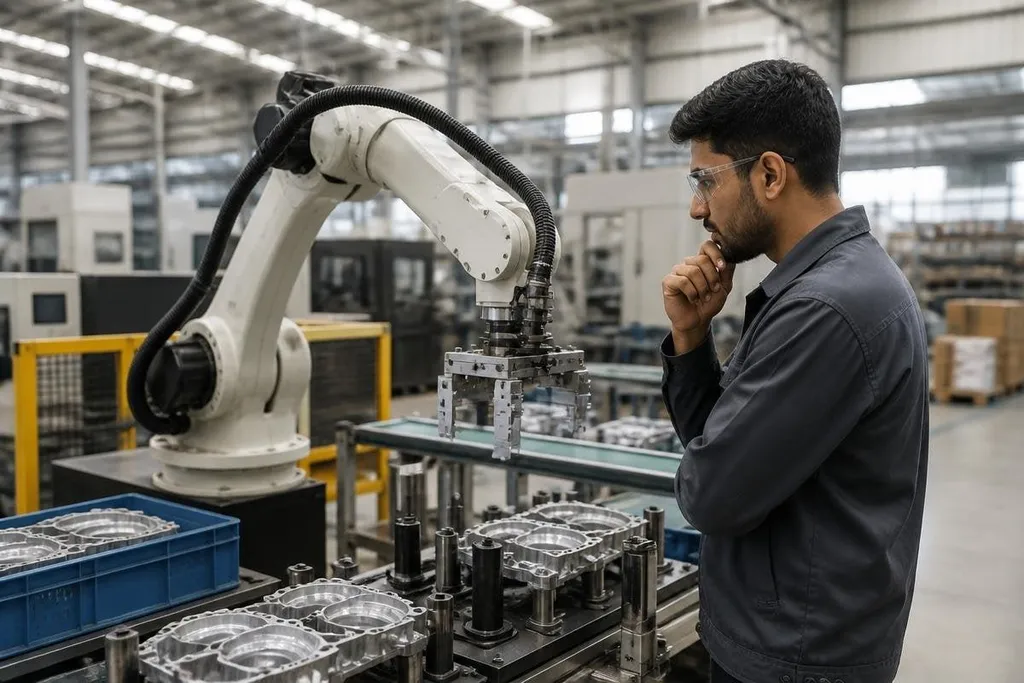
One robot arm can repeat the same move for hours, but buying one doesn't fix a factory by itself. For a plant manager in an emerging market, the case rests on a narrower question: can automation solve a real production problem at a cost the site can carry?
- Robotics can cover repetitive work when hiring or training is difficult.
- The project needs power, safety checks, maintenance, and trained staff.
- A pilot should prove output, quality, and payback before wider spending.
The work that attracts investment
Robotics makes the most sense where a task repeats often and mistakes cost money. A 6-axis robot arm can move parts between a conveyor and a fixture, while a gripper holds the part and a camera checks its position. That setup can reduce manual handling without changing the whole factory.
Factories may also use robots for welding, palletizing, painting, or inspection. These jobs differ, but the buying test stays the same: how many hours does the robot run, how often does it stop, and what happens when the part changes?
That last point matters in emerging markets, where a plant may make several products on one line. A robot built for one fixed task can sit idle when an order changes. A system with a tool changer, simple programming, and a local technician may earn its place sooner, even if its first task looks less ambitious.
Why the business case can look different
Labor cost is only one part of the calculation. A company may invest in robotics to hold a repeatable quality level, reduce exposure to hazardous work, or keep production running when skilled staff are hard to find. Those gains count only when the robot works inside the full process.
The full process includes the conveyor, power supply, safety fences, control software, spare parts, and people who fix faults.
A lower-priced robot arm can cost more to run if a failed motor leaves the line waiting for an overseas shipment.
Local support can matter as much as the arm’s payload. A plant manager needs a named contact who can replace a sensor, tune the motion, update the controller, and train the next shift. Dated robotics reports from Robot24.com can add named companies and work sites to that check before a low purchase price turns into a long wait for parts.
The limits behind the spending
Robotics does not remove the need for people. It changes the work around the machine. Operators still load parts, check exceptions, maintain equipment, and handle jobs that change too often for fixed automation.
Power quality can also shape the project. A site with voltage drops may need protection and backup equipment before it runs a robot safely. Dust, heat, moisture, and poor network links can affect cameras, motors, and control systems, so an IP rating and service plan belong in the purchase review.
The evidence pack for this topic contains no country data, investment totals, company names, or dates. That means a careful article can explain the reasons for spending, but it cannot rank emerging markets or claim that one region is investing faster than another.
A practical buying check
Use these questions before approving a robotics project:
- Name the task: record the motion, part weight, cycle time, and changeover needs.
- Check the site: confirm power, floor space, network access, lighting, and safety space.
- Price the full cell: include the arm, gripper, camera, controller, guarding, installation, and training.
- Plan the repair path: identify local service, spare motors, sensors, cables, and software support.
- Set a pilot test: agree on output, defect rate, downtime, and payback before the robot arrives.
- Choose the fallback: decide who runs the task if the robot stops during a shift.
This checklist turns a broad investment story into a plant-level decision. It also exposes weak projects early, before a low purchase price hides the cost of downtime.
I'd approve robotics for a task with steady demand, clear measurements, and local repair support. I'd wait when the plan depends on a demo, imported parts with long delivery times, or savings nobody has measured.
The next useful figure is not a regional investment total. It is the number of productive hours one robot can deliver at one named site, after setup, faults, training, and repairs.